
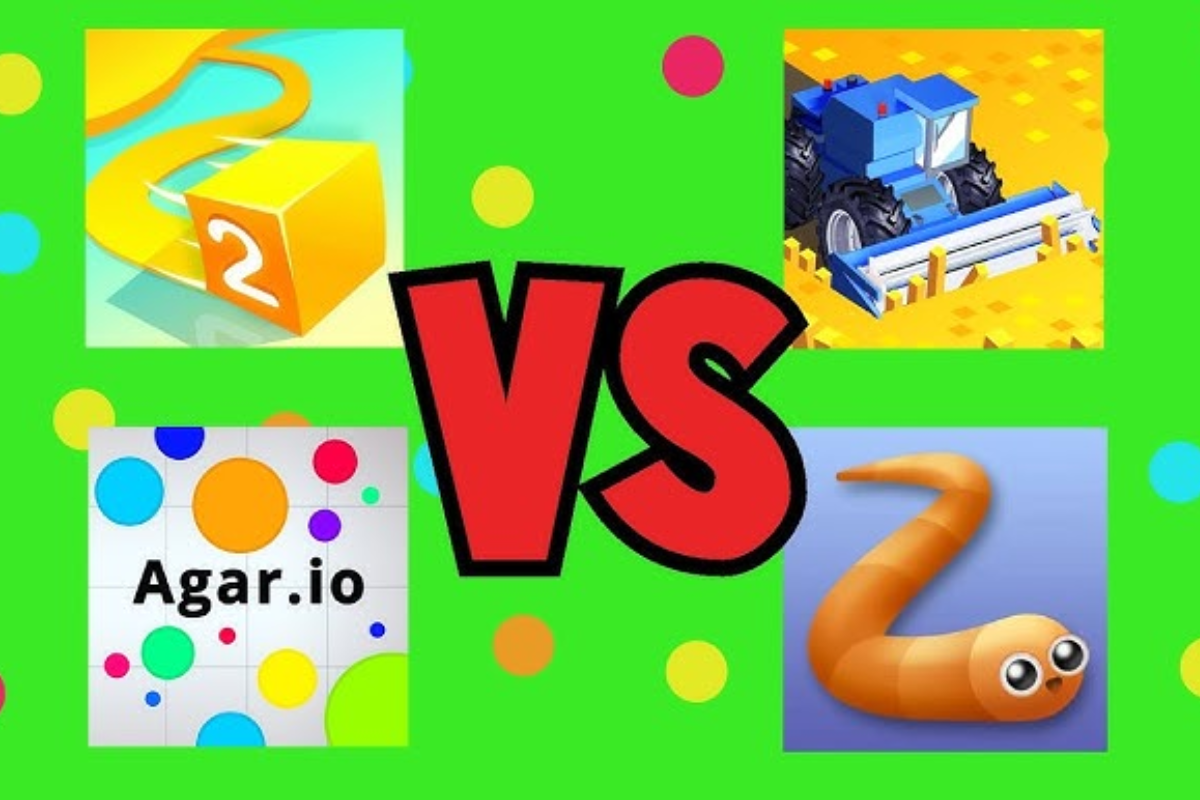
If you enjoy quick online multiplayer games that are simple to start but difficult to master, you have probably come across Agar.io vs Paper.io comparisons. Both games belong to the popular .io category and have attracted millions of players across mobile and browser platforms.
But when it comes to choosing between Agar.io and Paper.io, which one is better for you? Are they similar, or completely different experiences?
In this detailed guide on Agar.io vs Paper.io, you will understand their gameplay, strategy, difficulty level, and which game suits your personality and gaming style.
What Is Agar.io and How Does It Work?
Agar.io is one of the earliest .io games that became globally popular. The concept is very simple.
You control a small circular cell in a large open arena. Your goal is to grow bigger by:
- Eating small pellets scattered around the map. These pellets increase your size slowly, and are safe to collect when you are small.
- Absorbing smaller players. If your cell is larger than another player’s cell, you can consume them and grow quickly.
However, the danger is always present. Bigger players can eat you instantly. So survival is the core idea.
How Strategy Works in Agar.io
As you grow larger:
- Your movement speed reduces. This means you cannot escape easily from even bigger players.
- You must decide when to split. Splitting makes you faster and allows you to attack smaller players at a distance, but it also makes you vulnerable because your mass is divided.
- You can eject mass strategically. Advanced players use this to feed teammates or trap opponents.
In short, Agar.io is about balancing aggression and safety. If you play too aggressively, you get eaten. If you play too defensively, you grow very slowly.
What Is Paper.io and How Is It Different?
Paper.io looks simple at first, but its gameplay is very different from Agar.io.
Instead of growing in size, your main goal is to capture territory.
You control a coloured block that leaves a trail behind as you move outside your territory. When you create a loop and return safely to your base area, that enclosed space becomes yours.
But here is the twist:
- If another player touches your trail before you return to your territory, you are eliminated instantly.
- You can also eliminate others by cutting through their open trails.
So Paper.io is not about size. It is about land control and smart movement.
How Strategy Works in Paper.io
In Paper.io, every move carries risk.
- If you make a very large loop to capture more area, you are exposed for a longer time.
- If you play too safely and only capture small areas, you may never dominate the map.
- You must constantly watch opponents and predict their movement.
The gameplay feels more tactical. Instead of chasing players directly, you often trap them or cut their trails at the right moment.
Agar.io vs Paper.io: What Is the Core Difference?
When comparing Agar.io vs Paper.io, the biggest difference lies in the objective.
Growth vs Territory
In Agar.io:
- You grow bigger by consuming mass.
- Your size determines your power.
- The leaderboard is based on size.
In Paper.io:
- You increase your territory by enclosing areas.
- Control of land determines your dominance.
- The percentage of map control matters more than size.
This single difference changes the entire gameplay experience.
Which Game Is Easier for Beginners?
If you are new to .io games, you may wonder which one is easier to start with.
Agar.io for Beginners
Agar.io is easier to understand initially.
- Move around.
- Eat smaller things.
- Avoid bigger things.
The controls are simple and the goal is clear. However, surviving for long becomes difficult because experienced players dominate the map.
Paper.io for Beginners
Paper.io is also simple in concept, but beginners often make one mistake.
They try to capture very large areas immediately. This makes them easy targets.
In Paper.io, patience matters. You must slowly build your territory and understand opponent movement patterns.
If you prefer less chaos and more controlled gameplay, Paper.io might feel easier over time.
Is Agar.io More Competitive Than Paper.io?
When discussing Agar.io vs Paper.io, competitiveness is an important factor.
Agar.io feels more intense and chaotic because:
- The map is open and dynamic.
- Larger players hunt smaller ones aggressively.
- A single mistake can eliminate hours of growth.
The leaderboard constantly updates, which adds pressure.
Paper.io, on the other hand:
- Feels strategic rather than chaotic.
- Focuses more on territorial expansion.
- Encourages calculated risk instead of pure chasing.
If you enjoy high-speed survival challenges, Agar.io feels more competitive. If you prefer strategy and control, Paper.io offers a different kind of competition.
Which Game Requires Better Strategy?
Both games require strategy, but the type of thinking is different.
Strategy in Agar.io
In Agar.io, you must:
- Judge when to attack and when to escape.
- Use splitting wisely to capture opponents.
- Position yourself carefully near edges and larger players.
The strategy is reactive. You constantly adapt to the size of players around you.
Strategy in Paper.io
In Paper.io, you must:
- Decide how much territory to risk in one move.
- Predict enemy trails.
- Cut opponents at the perfect moment.
The strategy is more predictive. You think ahead and plan loops carefully.
If you enjoy mind games and calculated expansion, Paper.io may suit you better.
How Do Graphics and Visual Style Compare?
In the Agar.io vs Paper.io debate, visuals also play a role.
Agar.io has:
- A minimalistic petri-dish style background.
- Smooth circular cells.
- Simple and clean design.
Paper.io has:
- A colourful map divided into territories.
- Bright player colours.
- A grid-like movement style.
If you prefer a clean and calm design, Agar.io may appeal to you. If you enjoy colourful maps and visible dominance areas, Paper.io feels satisfying.
Which Game Is Better for Mobile Players?
Both games are available on mobile, but the experience can feel different.
In Agar.io:
- Touch controls are smooth.
- Splitting and movement are easy to manage.
- Fast reactions are important.
In Paper.io:
- Direction-based movement works well on mobile.
- The game feels slightly slower paced.
- You have more time to think before making moves.
If you prefer fast swiping and action-heavy gameplay, Agar.io works well. If you prefer controlled movement and steady expansion, Paper.io may feel more comfortable on mobile.
Agar.io vs Paper.io: Which One Should You Choose?
Now comes the main question in this Agar.io vs Paper.io comparison.
Choose Agar.io if:
- You enjoy survival challenges.
- You like growing stronger and dominating through size.
- You prefer fast-paced, unpredictable gameplay.
- You enjoy competitive leaderboards.
Choose Paper.io if:
- You like strategy and territory control.
- You enjoy planning and outsmarting opponents.
- You prefer steady progress instead of sudden elimination.
- You like visually seeing your control over the map.
Your gaming personality matters more than the popularity of the game.
Can You Play Both?
Absolutely.
Many players switch between the two depending on mood.
- If you want high-energy action and quick adrenaline, you can open Agar.io.
- If you want calm yet strategic gameplay, you can play Paper.io.
Since both games are simple and browser-friendly, you can easily try both and see which one keeps you engaged longer
Final Verdict: Agar.io vs Paper.io
In the debate of Agar.io vs Paper.io, there is no universal winner.
Agar.io focuses on survival, size growth, and fast reflexes. It gives you intense competitive gameplay where one mistake can end everything.
Paper.io focuses on territory control, calculated risk, and strategic movement. It rewards patience and smart planning.
If you want chaos and thrill, go for Agar.io.
If you want control and strategy, go for Paper.io.
The best choice depends on what kind of player you are.
At the end of the day, both games prove that simple mechanics can create highly addictive multiplayer experiences. Try both, understand their differences, and decide which one fits your style better.
That is the real answer to the Agar.io vs Paper.io debate.